



Exhaust After-Treatment Systems
Purpose, Objectives and Key Question
The purpose of the EATS Task is to support the transition of internal combustion engines (ICEs) from conventional fuels to advanced motor fuels with lower greenhouse gas (GHG) impact. This transition must be accompanied by a parallel reduction in pollutant emissions to avoid shifting the environmental burden from global climate impact to local air quality degradation. Therefore, the focus of this task is on the exhaust aftertreatment of combustion processes using advanced motor fuels.
The task aims to address the following core objectives:
- Characterize engine-out exhaust profiles resulting from the use of advanced motor fuels (AMF) in dedicated engine concepts.
- Ensure reliable measurement and quantification of pollutant species within complex exhaust matrices.
- Explore the potential of catalytic exhaust aftertreatment technologies to effectively reduce emissions.
- Provide science-based guidance to regulators by identifying viable technical concepts for emission control.
The central question this task seeks to answer is: Can EATS enable AMF to become a viable low-GHG, low-emission alternative to conventional fuels for ICEs?
Activities
The activities in Task 67 are carried out as a collaborative effort by participants from the AMF and Sustainable Combustion Technology Collaboration Programmes (TCPs). The project is structured into the following work packages (WPs), which span the duration of the Task:
- WP1 – Characterization of Exhaust Profiles: Focuses on the analysis of exhaust emissions from advanced motor fuels such as ammonia and methanol, under realistic engine operating conditions.
- WP2 – Catalytic Aftertreatment Evaluation: Addresses the investigation and performance assessment of catalytic exhaust aftertreatment systems for the control of emerging pollutants associated with advanced fuels.
- WP3 – Measurement Method Validation: Dedicated to the validation and evaluation of reliable and accurate measurement techniques for the quantification of exhaust gas pollutants.
- WP4 – Policy and Regulatory Recommendations: Aims to develop scientifically grounded recommendations for regulatory authorities to support emission reduction and facilitate the adoption of sustainable fuel technologies.
- WP5 – Task Management and Dissemination: Covers the coordination of project activities and the effective dissemination of results to relevant stakeholders.
During the reporting period, activities were primarily focused on WPs 1, 2, and 5.
WP5: Progress in Task 67 was initially delayed due to the absence of a Task Manager for several months, following Switzerland’s notification to the AMF that it was unable to provide the anticipated level of support for task management. At the 69th AMF Executive Committee meeting in May 2025, Ramin Mehrabian (LEC,[1] Austria) was approved as the new Task Manager for the EATS Task.
Subsequently, the “Formal Text” was finalized and submitted to the AMF Secretary in August 2025. The official kick-off meeting was successfully held in October 2025 with full participation by all partners. In addition, a series of webinars has been scheduled to facilitate in-depth discussions on recent research activities related to sustainable, climate-neutral fuels (e.g., ammonia, hydrogen, and e‑methanol) and their associated emission abatement technologies, with the aim of supporting net-zero GHG targets.
WP1 & WP2: During the last quarter of the reporting period, three online meetings were conducted to discuss the outcomes of several projects funded by the Transportation Technology Office at the U.S. Department of Energy. The goals of these projects are to explore alternative fuels to support the U.S. goal of energy addition of available fuels (methanol and ammonia), including but not limited to, renewable versions of such fuels. These projects are managed by Jim Szybist (National Transportation Research Center, Oak Ridge National Laboratory [ORNL]), and have met their International Energy Agency (IEA) goals.
- Recent findings (presented by Scott Curran [ORNL, USA]) focused on the evaluation of a conventional copper-zeolite selective catalytic reduction (SCR) system, combined with an ammonia (NH3) slip catalyst for controlling unburned NH₃ and nitrogen oxides (NOₓ) emissions from a dual-fuel, ammonia four-stroke, on-road engine (Figure 1). The results indicate that the Cu-based commercial SCR aftertreatment system may not be directly applicable to advanced fuels due to significantly different exhaust gas compositions and conditions. Furthermore, potential side reactions were identified, highlighting the need to investigate other SCR compositions to minimize the production of N2O emissions.
- Results from a project on methanol-fueled engines for marine and off-road applications (presented by Derek Splitter [ORNL, USA]) explored various combustion concepts and assessed emission characteristics. The findings demonstrated improved NOₓ and soot emission performance compared with conventional diesel engines, while also identifying specific challenges associated with methanol combustion (e.g., unburned methanol and the potential for formaldehyde).
- Selected results from an innovative project on alcohol-fueled engines (presented by Sreshtha Sinha Majumdar [ORNL, USA]) demonstrated strategies to control aldehyde emissions (including formaldehyde and acetaldehyde), which arise from incomplete combustion of methanol and ethanol, both in-cylinder and over catalytic systems. The use of platinum group metal (PGM)-based commercial oxidation catalysts showed promising results. Overall, the findings confirm that, while alcohol fuels are strong candidates for net-zero carbon energy systems, they present unique emission challenges — particularly aldehyde formation — that must be addressed prior to large-scale commercial deployment.
|
|
|
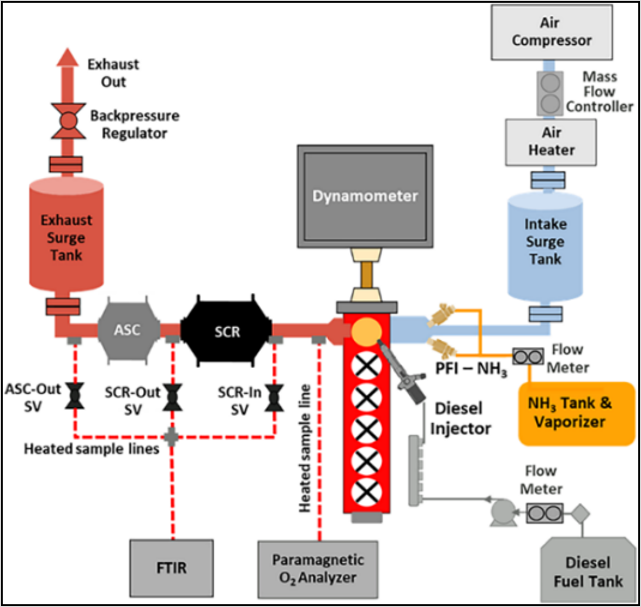
Figure 1: Test setup for experimental evaluation of emissions control strategies for a high-speed 4-stroke diesel engine running dual fuel (diesel/ammonia) (ORNL) [1]
Key Findings
- Operating large engines on NH₃ as a fuel continues to require significant development and optimization. Such engines produce extraordinarily high levels of NOx, N2O, and NH₃ compared with engines using other fuels. Therefore, exhaust gas aftertreatment solutions must be adapted to ensure compliance with legal pollutant requirements.
- Methanol is widely regarded as a promising fuel for achieving low net CO₂ emissions in internal combustion engines, particularly in the maritime sector. However, current combustion concepts tend to produce elevated levels of incomplete combustion products (e.g., formaldehyde [HCHO]) and unburnt methanol [CH₃OH].
Main Conclusions
Adopting alternative fuels such as ammonia and methanol requires careful consideration of exhaust gas aftertreatment requirements because meeting current emission regulations will necessitate the development of effective, application-specific aftertreatment solutions.
Publications
- Tyrewala, D., Prikhodko, V.Y., Kaul, B., and Curran, S. (2025) Simultaneous Control of Unburned NH3 and NOx Emissions from High Load Dual-Fuel Ammonia Operation on a High-Speed Diesel Engine Using a Cu-SCR System. ASME. J. Eng. Gas Turbines Power. 148(3). https://doi.org/10.1115/1.4069586.
- Kaul B., Tyrewala, D., Curran, S. (2025) Efficiency & Emissions of NH3-Diesel/Bio-Pilot Dual-Fuel Combustion in a High-Speed 4-Stroke Engine. CIMAC World Congress, Zürich, May 2025, paper 191.
- Curran S., Kaul, B., Tyrewala, D. (2025) Mapping ammonia-diesel combustion on a single-cylinder 107-mm bore diesel engine retrofitted for ammonia port-fuel injection. Int. J. of Eng. Res. 26(12):1951-1962. doi:10.1177/14680874251339739
- Splitter D., Szybist, J., Jatana, G., Svensson, K., and Montgomery, D. (2025) Approach for high methanol substitution by energy with conventional and bio pilot fuels. CIMAC World Congress, Zürich, May 2025, paper 037.
- Majumdar S.S., Rahman, M.M., Pihl, J.A. (2025) Reactivity of net-zero carbon alcohol fuels and their corresponding aldehyde intermediates on PGM-based commercial oxidation catalysts for lean-burn emissions control, Chem. Eng. J. 503(158490). https://doi.org/10.1016/j.cej.2024.158490.
[1] LEC – Large Engines Competence Center
|
Project Duration |
July 2024 - June 2027 |
|
Participants Task Sharing (AMF) Task Sharing (Sustainable Combustion TCP) |
Austria, Brazil, Canada, Denmark, Switzerland
|
|
Total Budget |
€ 8,350,000 (USD 9,462,000) |
|
Task Manager |
Ramin Mehrabian Bardar |