


Advanced Motor Fuels in Switzerland
Drivers and Policies
The cornerstone of Swiss energy policy is the energy article, which has been enshrined in the Federal Constitution since 1990. The Energy Act, the Carbon Dioxide (CO2) Act, the Climate and Innovation Act, and the Electricity Supply Act are all based on the energy article; together, they form the body of legislation on which Switzerland’s sustainable and modern energy policy is based.
In 2017, the Swiss public voted in favour of the revised Energy Act.[1] This act was the first step in implementing the 2050 Energy Strategy, which contains the following objectives:
- Increase energy efficiency;
- Promote renewable energy in Switzerland; and
- Phase out nuclear power.
At the end of 2020, the Federal Department of the Environment, Transport, Energy and Communications (DETEC) published its Energy Perspectives 2050+.[2] This document further develops the 2050 Energy Strategy by identifying technological paths in a series of scenarios, which outline the objectives of both energy policy (a secure and largely renewable energy supply by 2050) and climate policy (net zero emissions by 2050). Work on the new Energy Perspectives 2060 is currently underway.
Laws are periodically adapted to address new boundary conditions or strengthened to reflect recent developments. New or revised acts are subject to an optional referendum and can be rejected by the public, as happened to the revised CO2 Act,[3] which was rejected in June 2021. On March 15, 2024, an amended version of the revised CO2 Act was passed by Parliament and brought into force.
Based on an initiative submitted in November 2019, the Federal Council adopted a Federal Act on Climate Protection Goals, Innovation and Strengthening Energy Security.[4] After the Act passed the parliament in June 2022, opponents successfully filed a referendum against it. But in June 2023, the Swiss public voted (with 59.1%) in favor of this new Federal Act, which creates a framework for Swiss climate policy and sets interim targets for reducing greenhouse gas (GHG) emissions by 2050.
The draft Federal Act on a Secure Electricity Supply from Renewable Energy Sources[5] was approved by the Federal Council in June 2021. The draft Act is based on the conclusions of Energy Perspectives 2050+ and results from a revision of the Energy Act and Electricity Supply Act. The key aim is to strengthen Switzerland’s security of supply, particularly in the winter months, by expanding domestic renewable electricity production and setting binding expansion targets and energy consumption reduction targets. Parliament passed the bill in September 2023. Because a referendum was successfully filed against it, a public vote was held in June 2024. The revision of the Acts was accepted with 68.7% approval, and the Act came into force in January 2025.
CO2 Emission Regulations for Cars
CO2 emissions regulations for new cars apply in Switzerland just as they do in the European Union (EU). Until 2020, the measurement procedure and limit values of the New European Driving Cycle (NEDC) applied. Since 2021, the CO2 emissions of vehicles have been determined according to the WLTP (World Harmonized Light-Duty Vehicles Test Procedure).
In 2025, the revised CO2 Act lowered the CO2 emissions target for newly registered passenger cars to 93.6 g CO2/km. A further reduction to 49.5 g CO2/km is foreseen for 2030. A CO2 target regulation for heavy-duty vehicles (HDVs) also came into force for the first time in 2025. Importers of new HDVs must reduce average emissions by 15% compared with the reference values established in the EU regulation and by 30% beginning in 2030. Each importer’s vehicle fleet must comply with an individual target based on these values. If the target is exceeded, the importer will pay a penalty.
The average CO2 emissions of all cars in 2024 amounted to around 113.9 g CO2/km — roughly 1 gram higher than in 2023 (112.7 g CO2/km), but still well below the target value of 118 g CO2/km (Figure 1). The slightly higher emissions resulted in a 28% higher penalty of EUR 2.38 million in 2024.[6] This can be explained by the slightly lower market share of electric vehicles in 2024 and by the expectation of the lower emission targets in 2025.
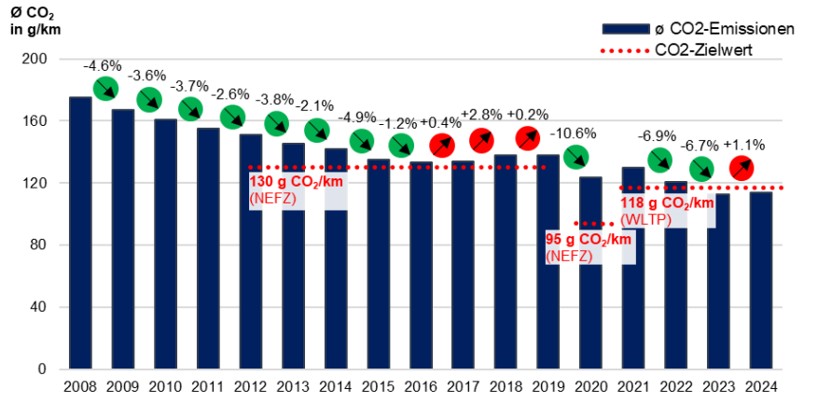
Figure 1. Average annual CO2 emissions of passenger cars registered for the first time and reduction rates from 2008–2024. The arrows and percentages show the change compared with the previous year.
CO2 Emissions Compensation: Motor Fuels
Importers of fossil motor fuels are required to compensate a certain amount of the CO2 emissions (regulated by the CO2 ordinance per year) caused by transport. They may conduct their own projects or acquire certificates. The compensation rate in 2023 was 20%; the rate increased to 23% in 2024.[7] A minimum of 15% must be compensated by means of domestic measures. The Swiss Petroleum Association established the Foundation for Climate Protection and Carbon Offset (KliK), which launches and subsidizes projects to reduce CO2 emissions in fields such as transportation, industry, buildings, and agriculture. Another measure to reduce CO2 emissions is to blend fossil fuels with biofuels. Because Switzerland is under no legal obligation to blend fossil fuels, emissions compensation is the only driver for blends.
Mineral Oil Tax Reduction for Natural Gas and Biofuels
To support the target for CO2 emissions, a reduction — or even an exemption — for environmentally friendly motor fuels was enacted in 2008. Biofuels that satisfy minimum environmental and social requirements are completely or partially exempt from the mineral oil tax. As a result, the tax reduction for biofuels is up to EUR 0.77 (USD 0.83) per liter, compared with fossil fuels. The mineral oil tax reduction is valid until the end of 2030.[8] To offset the loss of tax revenue from this tax cut, the fossil fuel tax will be gradually increased until 2037.
Advanced Motor Fuels Statistics
The following numbers and statements are based on 2024 statistics (i.e., as of 31 December 2024).
Energy and Fuels
Final total energy consumption in Switzerland in 2024 amounted to 776,220 terajoules (TJ), representing an increase of 1.0% compared with the previous year, largely because of greater consumption of aviation fuels and colder weather. The 5+-year comparison (2019 vs. 2024, omitting 2020) shows a decrease in Switzerland’s total energy consumption of 7.2%, which corresponds to 61 TJ. The decline was mainly caused by reduced use of petroleum products (-12.8%) and natural gas (-17.2%). The climatic differences between 2019 and 2024 (calculated using the heating degree index [HDD]) resulted in a 6.7% reduction in heating demand. Overall, the climate-adjusted consumption of fossil fuels has fallen by approximately 15%. Electricity consumption increased only slightly, by 1,100 TJ or 0.5%, during this period. For several years now, energy consumption in Switzerland has been decoupled from population and economic growth due to increasingly rational use of energy.
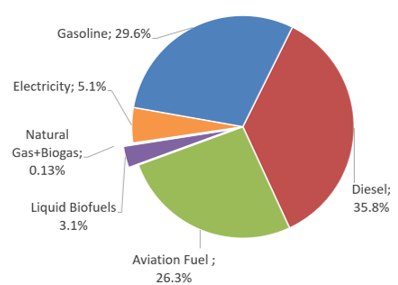
Gasoline and diesel consumption declined in 2024 compared with the previous year. (gasoline -1.1%, diesel -2.9%). Consumption of aviation fuels rose by 9.1% compared with 2023 — but was still 4.2% below pre-pandemic levels (2019). Overall, fuel consumption was 0.9% higher than in 2023. The transport sector accounts for 38% of total Swiss energy consumption; all fossil fuels were imported (Figure 2).
When importers of fossil motor fuels began blending fossil fuels with biofuels in 2014, the use of liquid biofuels rose from 29.4 million liters in 2014 to 338.9 million liters in 2024.
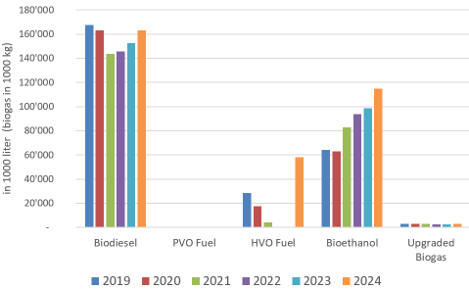
In 2024, 163.1 million liters of biodiesel and 114.9 million liters of bioethanol were used (see Figure 3). Hydrotreated vegetable oil (HVO) has been used in Switzerland only since 2016 and is 100% imported, with significant annual fluctuations; 2024 saw a sharp increase (to 58.9 million liters) in the use of HVO. Use of pure vegetable oil (PVO) for fuel is almost negligible (36,000 liters). Upgraded biogas as a transport fuel remained at a low level (2.8 million kg).[9]
|
Figure 2. Shares of Energy Sources in the Transportation Sector in Switzerland, 2024[10] |
Figure 3. Use of Biofuels as Motor Fuels in Switzerland, 2019–2024 |
Only 17.7 million liters of biodiesel were produced in Switzerland; the remaining 145.4 million liters, as well as all bioethanol and HVO, were imported.[11]
The total amount of biogas produced and used in Switzerland in 2024 was 139.0 million kg. Only 37.4 million kg has been upgraded and fed into the natural gas grid. Of this, 2.8 million kg was sold as biogas for cars, and the remainder (92.5%) was used for heating residential buildings or in industry. Compared with the amount produced, demand for biogas as a motor fuel is very low. A total of 5.7 million kg of natural gas was used as fuel — 40.8% less than in 2019 (Figure 4)
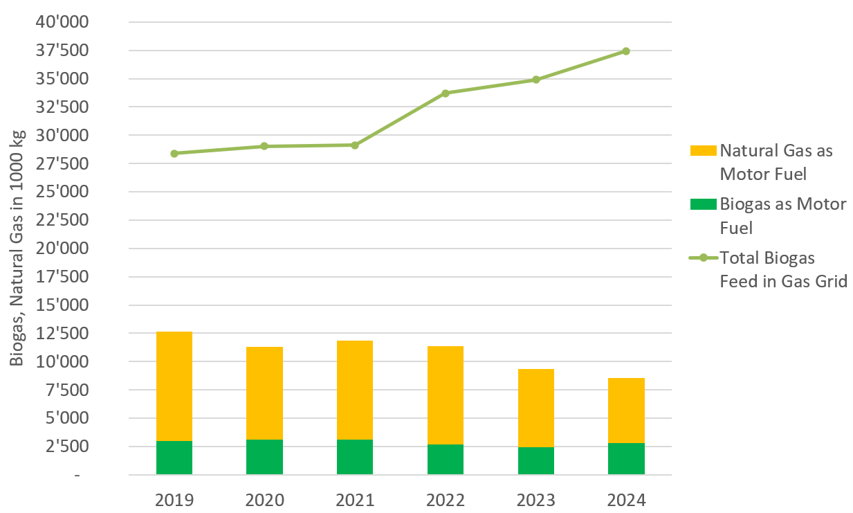
Figure 4. Development of Natural Gas and Biogas as Motor Fuel for Cars and Total Upgraded Biogas Fed into the Natural Gas Grid (green line)
Motor Vehicles
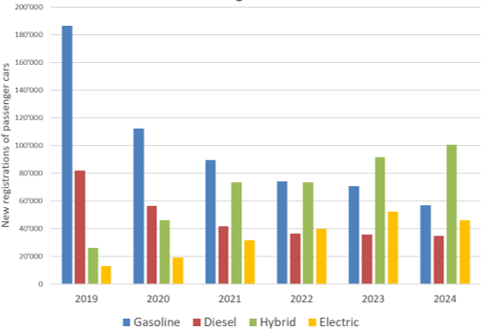
In 2024, 238,103 passenger cars were newly registered in Switzerland, representing a decrease of 4.6% compared with 2023 and a decrease of 22.9% compared with 2019. The number of newly registered hybrid cars rose by 9.9 %, while electric car registrations decreased by 11.7%. Sales of purely gasoline-fueled cars dropped sharply (by 19.8%), and sales of diesel-fueled cars decreased by 2.3%. Compared with 2019, sales of cars powered only by fossil fuels declined by 59.8%. In contrast, sales of hybrid vehicles rose by 284%, and sales of electric vehicles increased by 253% in the same period (Figure 5). The slight decrease in electric vehicles could be attributed to reintroduction of import taxes for electric cars and the lower emission targets in 2025.
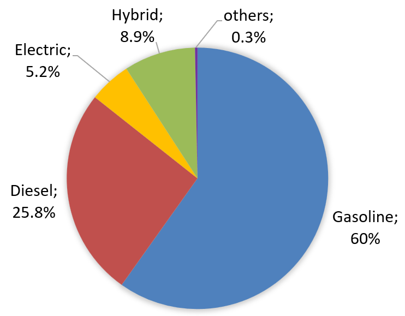
Despite the increasing number of new registrations of electric and hybrid passenger cars in recent years, their share of the total fleet on the road is still small. Figure 6 illustrates this fact, using passenger cars as an example. Nonetheless, the share of electric and hybrid vehicles is steadily rising, while the numbers of pure gasoline- and diesel-powered cars are going down.
|
Figure 5. New Registrations of Passenger Cars |
Figure 6. Passenger car share by fuel/drive train, 2024. (Total fleet is 4,805,564 cars) |
Research and Demonstration Focus
The Swiss Federal Office of Energy (SFOE) has three funding schemes for subsidiary support of energy-related projects.
- The main focus of the Energy Research Programmes is application-oriented research and development (R&D).
- The Pilot and Demonstration (P+D) Programme promotes the testing and implementation of new technologies, solutions, and concepts.[12]
- The purpose of the SWEET (“SWiss Energy research for the Energy Transition”) Programme is to accelerate innovations that are key to implementing Switzerland’s Energy Strategy 2050 and achieving the country’s climate targets.[13]
The overarching goals of all funded projects are to foster energy security, energy efficiency, decarbonization, and renewable energies.
Ongoing pressure to cut federal spending is also affecting energy research. While the P+D Programme has been suspended completely for the time being, funding for the Research Programmes remains uncertain because it requires annual approval by Parliament. As a consequence of recent cuts, the Research Programmes have been reprioritized, leaving significantly lower funds available for combustion research.
According to Scenario ZERO Basis (of the Swiss Energy Perspectives 2050+), after 2050, the transport sector should be operated without fossil fuel. That means reductions from 197.3 PJ gasoline, diesel, and natural gas plus 7.2 PJ biofuels and 13.7 PJ electricity in 2023 to 71.9 PJ renewable fuels and 60.7 PJ electricity in 2050 (data without fuels for aviation, which totaled 71.2 PJ in 2023). Figure 7 displays final energy demand.
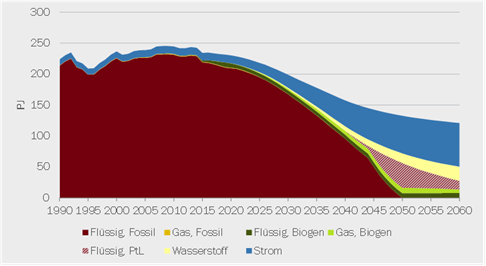
Figure 7. Final Energy Demand of Domestic Transport (Scenario ZERO Basis, Excluding International Aviation)[14]
Owing to the clean (almost CO2-neutral) electricity generation in Switzerland and the relatively short travel distances, the electrification of transportation — including passenger cars and trucks — has clear priority. Renewable (low-carbon) fuels are being considered for hard-to-electrify sectors such as aviation, shipping, and certain off-road applications (agriculture/construction).
The projects described below cover the production, storage, and distribution of the fuels, as well as their highly efficient use in internal combustion (IC) engines and exhaust gas after-treatment. The combustion and engine-relevant properties of biogas, hydrogen (H2), methanol (MeOH), dimethyl ether (DME), and ammonia (NH3) are also being investigated.
SWEET refuel.ch: Renewable Fuels and Chemicals for Switzerland (2023–2030)[15]
To comply with the ambitious timeline of Swiss renewable energy and GHG emission targets, accelerated market development of sustainable fuels and platform chemicals is necessary. While first-generation technology is available to initiate a ramp-up, this is not the case for policies, laws, regulations, and markets (non-technical aspects). A first aim of the SWEET reFuel.ch project to investigate how investment security can be improved by closing this knowledge gap. A second aim is to strengthen innovative technologies currently at low technology readiness levels (TRLs). This goal will be achieved by focusing on renewable methane pathways and other technologies with breakthrough potential for sustainable fuel and platform chemical production.
NH3 ICE ammonia combustion engine (2023–2027)
Ammonia is primarily considered for powering large marine engines. In this project, currently being conducted by Liebherr Machine Bulle SA, ammonia will be used for medium- to high-speed engines for mining machinery, smaller marine vessels, or cogeneration. A Liebherr prototype ammonia/
hydrogen 4-stroke engine — fully equipped with sensors, fuel injection system, and open electronic control unit — was installed at the experimental facilities of R&D Moteurs in France. The research team will quantify ammonia slip and nitrous oxide (N2O) emissions and perform emission measurements of secondary and particulate formations.
E-Methanol compression-ignition combustion (2023–2027)[16]
Renewable methanol is a technically and economically promising solution to achieve net-zero CO2-free IC engines for applications that cannot be electrified. The novelty, compared with existing methanol engines, is the use of a compression-ignition process (quasi “methanol diesel engine”) to achieve the highest efficiency and power density. The researchers will evaluate the feasibility and limitations of e‑methanol using an optically accessible test bench to investigate the underlying mechanisms under relevant pressure, temperature, and flow conditions, as well as different injection strategies. In addition, researchers will evaluate ignition-promotion concepts that could be required.
Combustion system with alternative pre-chamber fuels (2024–2026)[17]
The need to make IC engines more efficient, while reducing emissions and improving their ability to operate reliably with new synthetic fuels, has led to the development of a new, advanced combustion process: Spark-Assisted Compression-Ignition (SACI). Combined with an active pre-chamber, SACI can reliably control the auto-ignition of the premixed cylinder charge, resulting in an efficient combustion process suitable for new, difficult-to-burn synthetic fuels or very lean air-fuel mixtures. The aim of this project is to investigate the influence of the reactivity of the pre-chamber fuel on the hot reactive jets and the subsequent (partial) auto-ignition of the main chamber charge. Hydrogen is used for high reactivity and ammonia for low reactivity in the pre-chamber.
N2O Exhaust Gas Treatment in Ammonia Engines II (2024–2027)[18]
NH3 is considered a promising fuel for large engines and, in particular, for international shipping applications, because no CO2 is produced from its combustion. However, high concentrations of the pollutants NOx, NH3, and N2O have been measured on prototypical large engine setups. The aim of this continuation project is to follow up on analysis and understanding of catalyst behavior in the complex exhaust gas containing these components, allowing researchers to propose recommendations to reduce pollutant emissions from prospective NH3-fueled engines. Researchers are studying catalysts based on Fe-exchanged zeolites by analyzing the influence of acidic properties on catalytic activity, as well as by exploring the effects of hydrothermal and chemical aging. In addition, the exhaust gas composition of real NH3 engines is considered, for example by including other pollutants such as hydrocarbons in the model gas investigations in the laboratory.
Outlook
The share of electric or plug-in hybrid cars in Switzerland continues to rise. While 2024 was a difficult year for electric drives, the EV market recovered in 2025 despite a still-struggling overall car market in Switzerland. The share of plug-in vehicles (battery-electric [BEVs] and plug-in hybrids [PHEVs]) reached 34% in 2025. Particularly fast growth can be seen in the heavy-duty segment, where battery electric trucks already exceeded 20% of sales in 2025.
The demand for fossil fuels will therefore further decrease, and electricity consumption will increase. The number of charging stations for electric vehicles is growing commensurably with the growing fleet of electric vehicles.
For the remaining transport systems powered by IC engines (still part of long-distance transport, maritime transport, various off-road applications, and combined heat and power), research institutes and industry are looking for the most suitable solutions using renewable fuels. The focus here is primarily on H2, but also on NH3, methanol, DME, and biofuels. The challenge is that it is not yet clear which of these fuels is the most suitable and will prevail.
Cooperative R&D around renewable fuels and their use in combustion systems is therefore important. Just as for electric mobility, the systems for supplying renewable fuels must also be set up expeditiously and, where possible, the existing ones must be converted. The production and procurement of non-fossil fuels are also of great importance here.
Major changes
The new Act on a Secure Electricity Supply from Renewable Energy Sources went into force in January 2025. Dynamic tariffs and new business models to allow greater flexibility should make charging of electric vehicles cheaper and facilitate the integration of renewable energy.
Electric vehicles (BEVs and PHEVs) gained additional traction in 2025 with a market share of 34%. Together with hybrid vehicles (35.3 %), alternative drives constituted 69.4% of all newly registered cars. In the heavy-duty sector, sales of electric trucks doubled in 2025 and reached 21.4% of new registrations.
Sales of biofuels rose slightly in 2025 owing to increased availability of HVO. The blending ratio in diesel could be elevated to 7.3%.
Benefits of participation in AMF
The future of IC engines depends, among other things, on the successful market introduction of reduced-CO2 fuels. The AMF TCP is a pioneer in researching and describing novel fuels and their application, benefits, and effects in terms of efficiency and emissions. AMF is a unique source of information and a platform for international exchange of experience and cooperation.
[1] Fedlex, Energy Law SR 730.0, https://www.fedlex.admin.ch/eli/cc/1999/27/de
[2] Swiss Federal Office of Energy (SFOE), “Energy perspectives 2050+,” https://www.bfe.admin.ch/bfe/en/home/policy/energy-perspectives-2050-plus.html/.
[3] Fedlex, 641.71: Federal Act on the Reduction of CO2 Emissions, https://www.fedlex.admin.ch/eli/cc/2012/855/en.
[4] Federal Act on Climate Protection Goals, 2022, “Innovation and Strengthening Energy Security.”
[5] Swiss Federal Office of Energy (SFOE), 2021, “Federal Act on a Secure Electricity Supply from Renewable Energy Sources.”
[6] SFOE, 2025, “Vollzug der CO2-Emissionsvorschriften 2024.”
[8] Mineralölsteuergesetz (MinöStG), Stand: March 15, 2024.
[9] SFOE, 2025, “Schweizerische Statistik erneuerbarer Energien 2024.”
[10] SFOE, 2025, “Gesamtenergiestatistik 2024.”
[11] Swiss Custom Administration, 2024, “T2.8 Biogene Treibstoffe 2023.”
[12] The P+D Programme has been suspended since October 2024 as part of federal budget cuts. No new projects have been accepted since then, but support for ongoing projects has been secured.
[13] SFOE, “Energy Strategy 2050,” https://www.bfe.admin.ch/bfe/de/home/politik/energiestrategie-2050.html.
[14] SFOE, 2022, Energy Perspectives 2050+, Technical Report.
[15] Swiss Federal Office of Energy, “SWEET: reFuel.ch,” https://www.sweet-refuel.ch/.
[16] FHNW ITFE (University of Applied Sciences Northwestern Switzerland, Institute of Thermal and Fluid Engineering), “EMOCION – E-Methanol Compression Ignition Combustion,” project 502699 in ARAMIS (Administration Research Actions Management Information System), https://www.aramis.admin.ch/Texte/?ProjectID=53959.
[17] FHNW ITFE “SACI II – Combustion system with alternative pre-chamber fuels,” project 502840 in ARAMIS, https://www.aramis.admin.ch/Texte/?ProjectID=55940.
[18] PSI (Paul Scherrer Institute), “N2Ooff II – N2O exhaust gas treatment in ammonia engines – II,” project SI/502902 in ARAMIS, https://www.aramis.admin.ch/Texte/?ProjectID=56158.